
Forced Reset Triggers (FRTs) are a category of firearm trigger mechanisms whose legality has been shaped by statutory language, agency interpretation, federal court review, and state legislation.
Because these devices sit at the intersection of mechanical design and regulatory definition, their legal treatment has been unusually complex.
This article provides a technical and legal explanation of:
How the Supreme Court and the Department of Justice responded
This document is educational only and does not constitute legal advice.
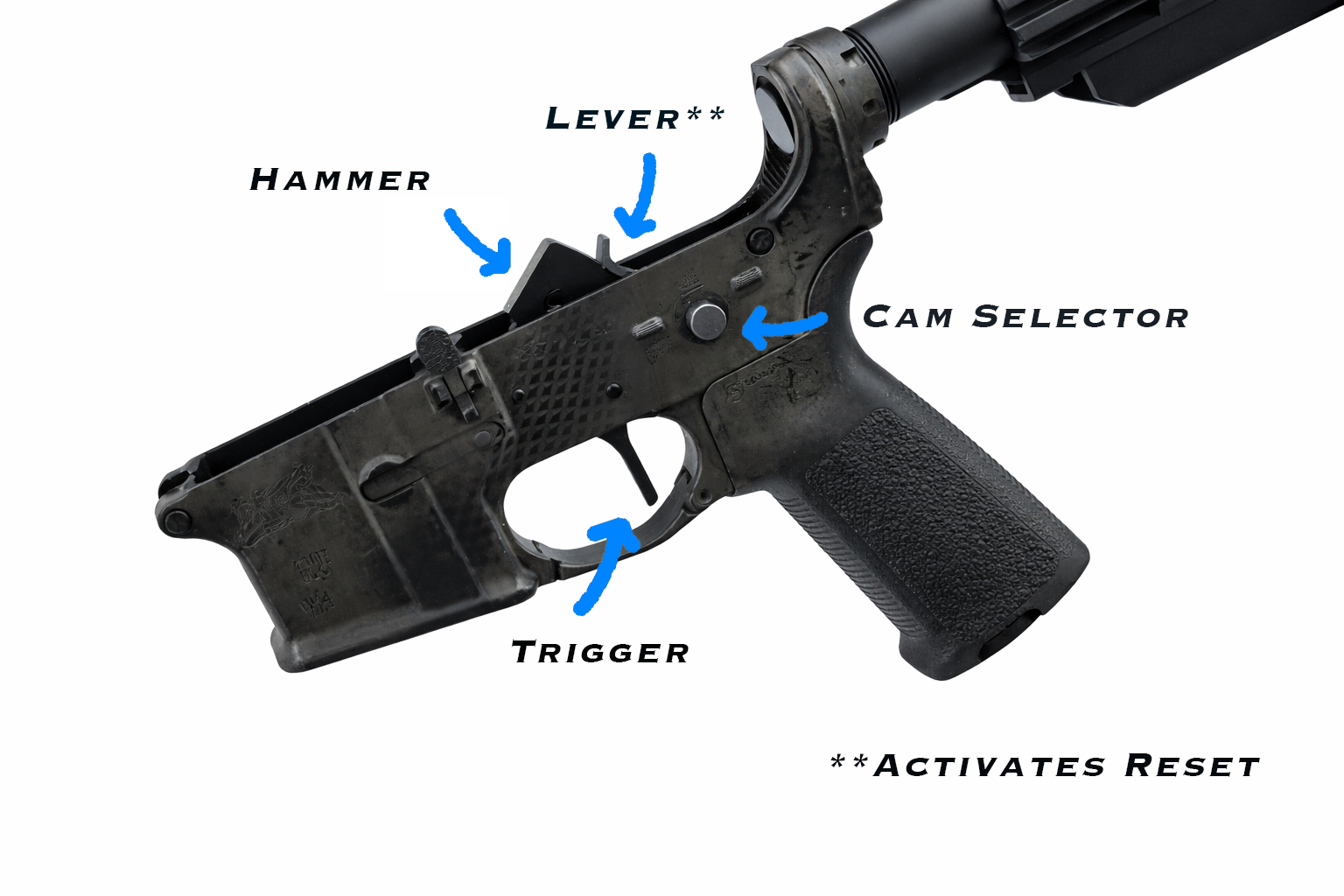
A Forced Reset Trigger is a mechanically assisted semi-automatic trigger system. Its defining feature is that the trigger is actively reset forward by mechanical force during the firearm’s operating cycle.
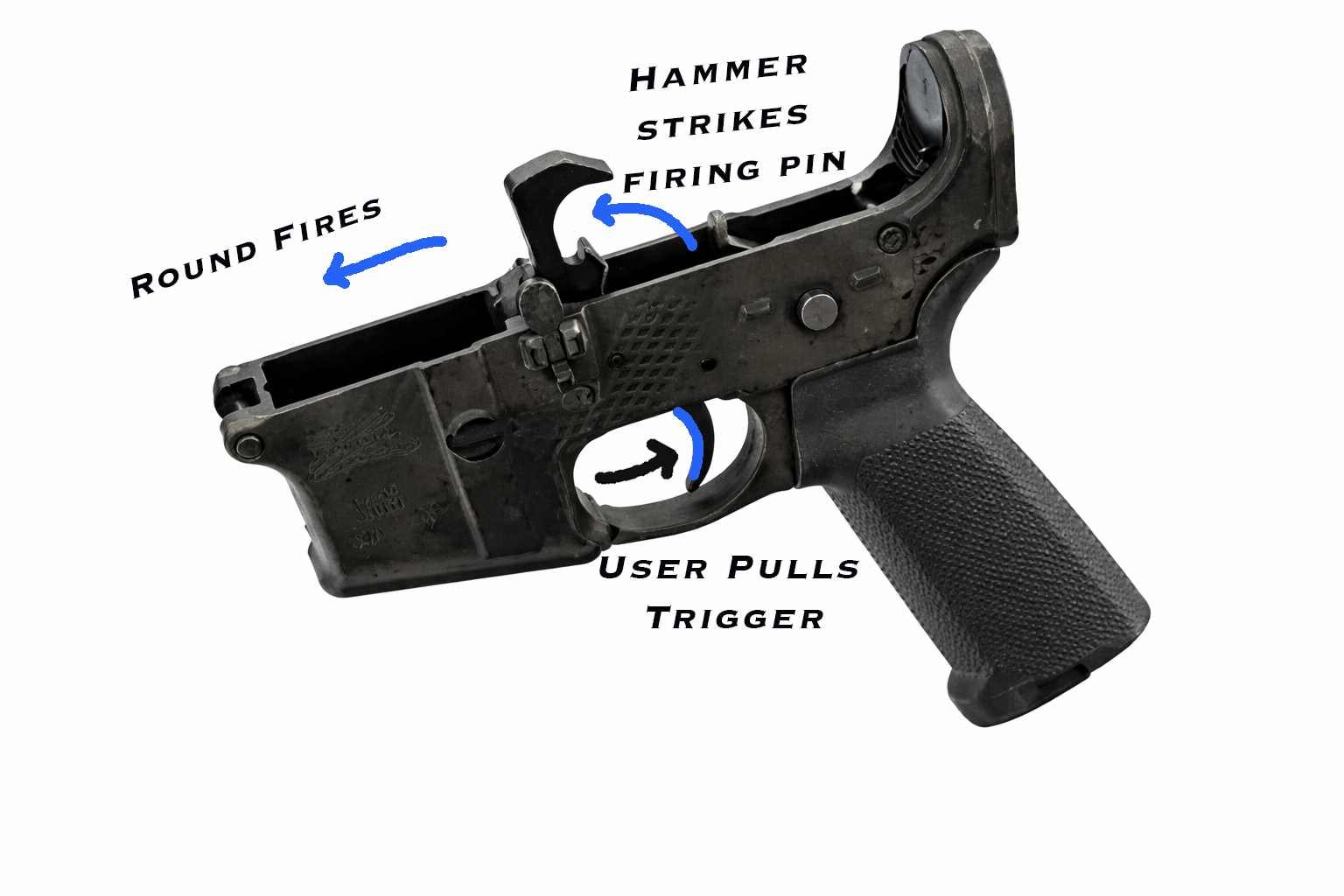
The shooter pulls the trigger
The hammer releases and strikes the firing pin
The firearm discharges one round
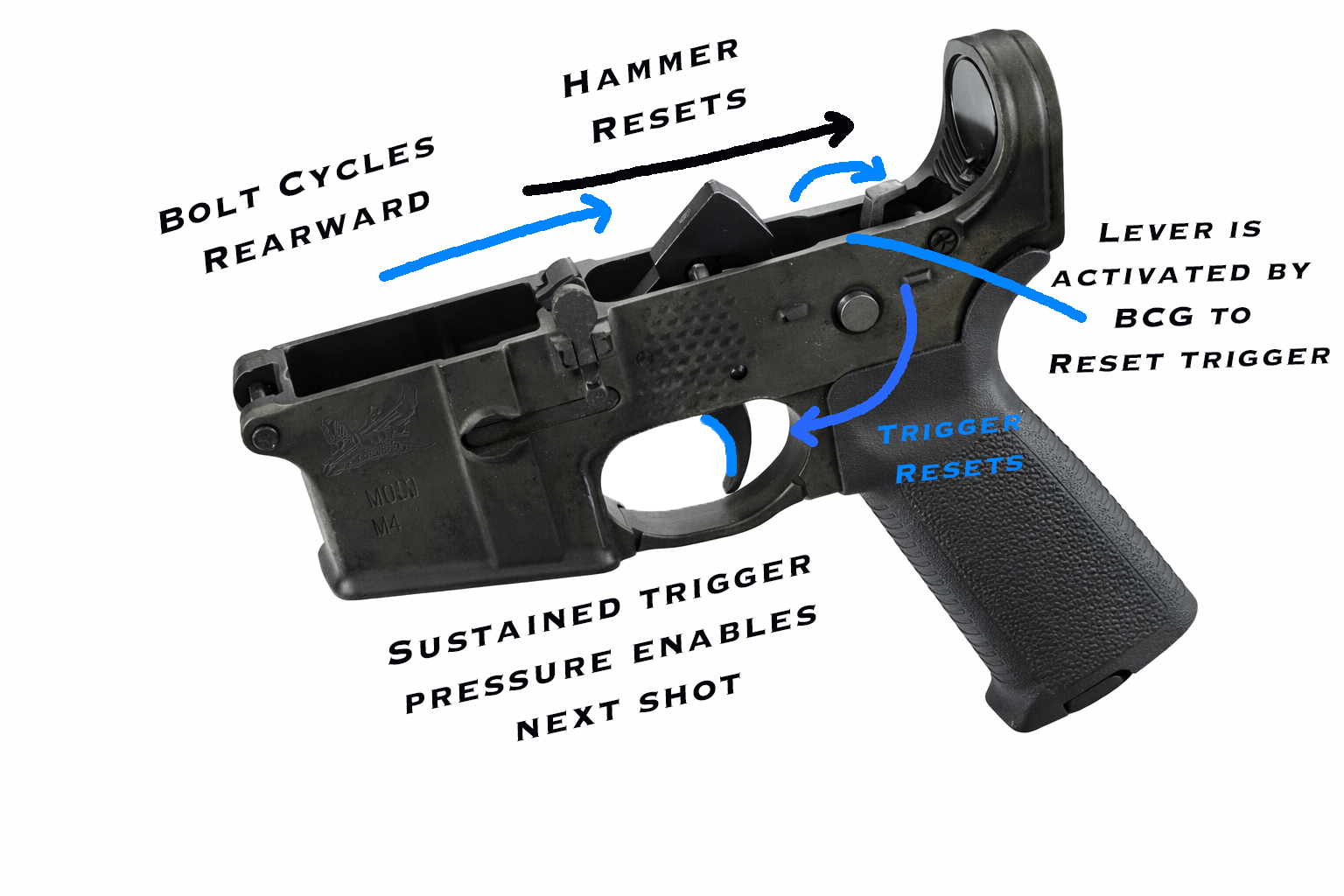
The bolt carrier group cycles rearward
During rearward travel, a reset mechanism pushes the trigger forward
The trigger is returned to the ready position before the bolt closes
The shooter must apply pressure again for the next shot
Critically:
Each shot corresponds to a hammer release
The trigger does reset between shots
No continuous firing occurs without repeated trigger engagement
This mechanical distinction is central to all legal analysis.
Federal firearm classification is governed by:
The National Firearms Act (NFA) (26 U.S.C. § 5845)
The Gun Control Act (GCA) (18 U.S.C. § 921)
Under federal law, the term machine gun is defined as:
There is a quiet care in how this definition is written. Rather than chasing speed, sensation, or mechanical nuance, Congress chose a simple, observable standard: whether more than one round is discharged by a single trigger function. That restraint gives the law clarity and staying power, allowing it to be applied thoughtfully across different designs and generations of technology without drifting into subjectivity.
Statutory source: 26 U.S.C. § 5845(b)
Beginning in 2021, the Bureau of Alcohol, Tobacco, Firearms and Explosives (ATF) issued classification letters asserting that certain forced reset triggers constituted machine guns.
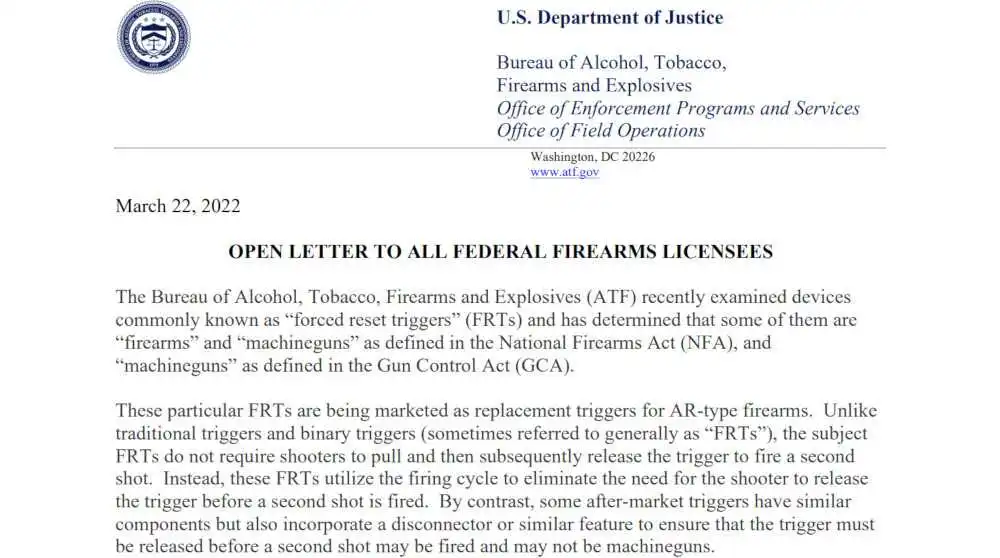
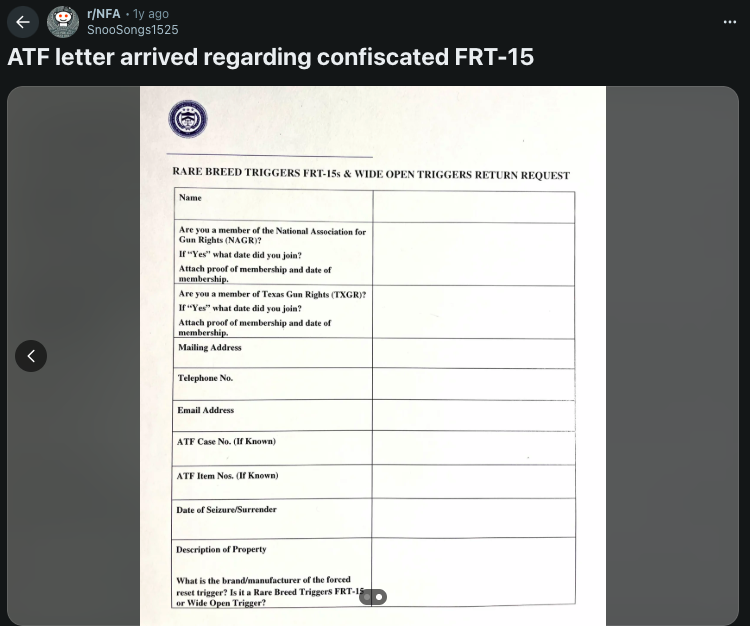
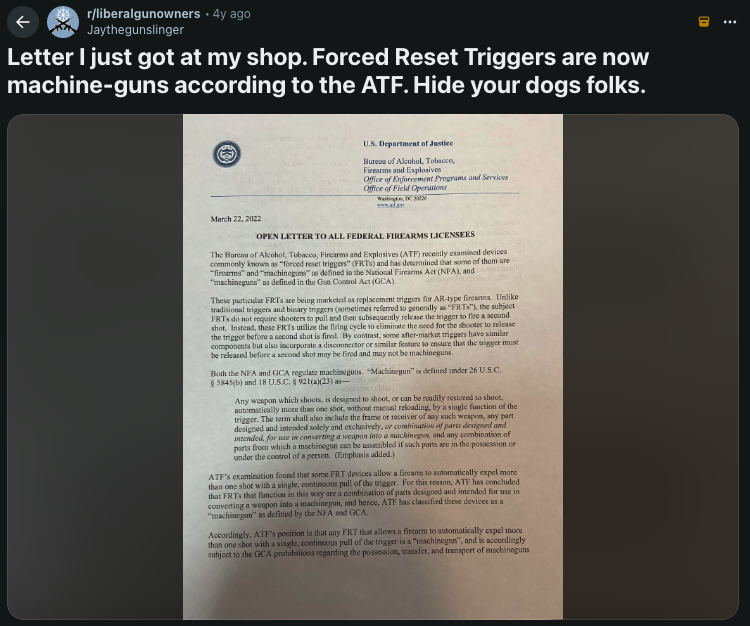
The ATF’s reasoning focused on trigger function, not firing speed. Specifically, the agency argued that some FRT designs allowed repeated firing while a shooter maintained continuous rearward pressure, and that this behavior could constitute multiple shots resulting from a single “function” of the trigger.
Based on this interpretation:
ATF initiated enforcement actions
Devices were seized or collected through recall and surrender processes
Manufacturers were directed to halt production and distribution
Original Open Letter from ATF
ATF Link: https://www.atf.gov/frt-open-letter (now removed)
Under U.S. administrative law, federal agencies such as the ATF are permitted to interpret and enforce statutes within the scope delegated by Congress. However, that authority is not unlimited. Courts retain the power to review agency interpretations and invalidate them when they exceed legal boundaries.
In general, courts may reject an agency’s interpretation if it:
In Garland v. Cargill (2024), the U.S. Supreme Court considered whether a bump stock qualifies as a “machine gun” under 26 U.S.C. § 5845(b). Although the case involved bump stocks rather than forced reset triggers, the Court’s analysis focused on the same statutory phrase: “single function of the trigger.”
The Supreme Court held that:
A machine gun requires more than one shot per single trigger function
Devices that require repeated trigger functions do not meet the statutory definition
Even if those functions occur rapidly
Even if mechanical assistance is involved
Firing speed alone is not legally determinative
Functional similarity to automatic fire is insufficient
Federal agencies may not expand statutory definitions beyond what Congress enacted
The Court made clear that:
Statutory interpretation must begin and end with the text
Congress chose precise mechanical language
Courts may not substitute policy concerns for statutory meaning
Agencies must operate within the limits of congressional authorization
Although the case did not involve FRTs, its reasoning directly informs how courts evaluate trigger-based devices:
A trigger function is a discrete mechanical event
Continuous pressure is not the same as a single trigger function
Rate-enhancing mechanisms must still be evaluated by trigger function, not outcome
Agency interpretations must align with the statute’s plain meaning
After Garland v. Cargill:
Courts reviewing ATF classifications must apply textual analysis
Statutory definitions cannot be broadened through enforcement alone
New regulatory outcomes require new legislation, not reinterpretation
The decision serves as a clear judicial boundary, reinforcing:
Congress’s role in defining criminal prohibitions
The courts’ role in ensuring those definitions are applied as written
In 2025, the U.S. Department of Justice entered into a settlement resolving litigation with Rare Breed Triggers.
Key settlement outcomes:
Important limitations:
DOJ official press release:
https://www.justice.gov/opa/pr/department-justice-announces-settlement-litigation-between-federal-government-and-rare-breed
As of 2026:
However:
This creates a conditional federal posture, not permanent authorization.
Under U.S. federalism:
Many states prohibit devices classified as:
California explicitly bans forced reset triggers as illegal multiburst trigger activators.
Illinois reaffirmed state prohibition and coordinated with ATF to prevent redistribution.
Sixteen states filed litigation opposing federal non-enforcement.
Federal courts interpret federal statutes.
State legislatures write independent state criminal codes.
Therefore: